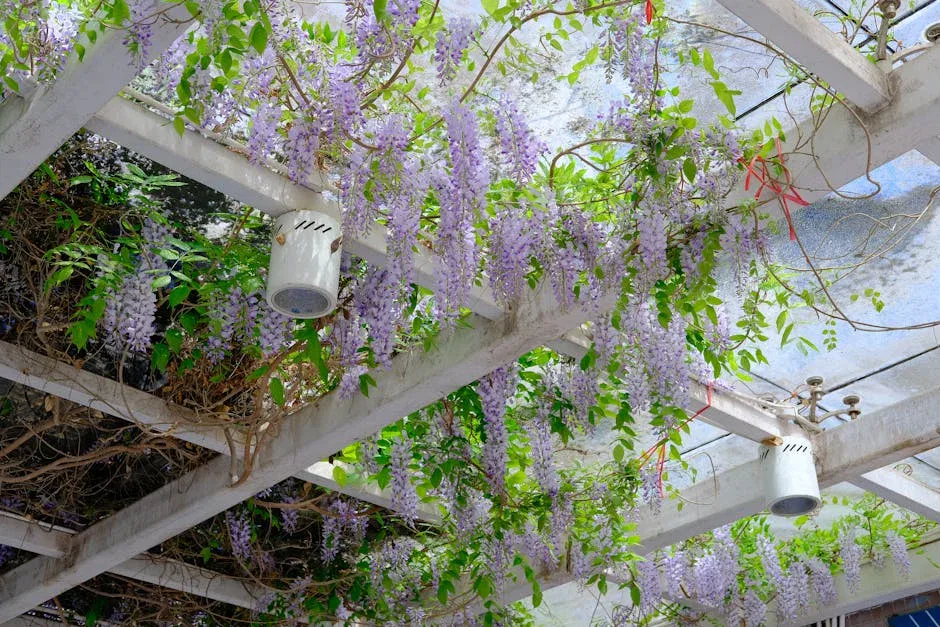
Climbing plants can transform a bare fence, dull wall, or awkward corner into a lush, living feature that adds real character to any garden. Many gardeners struggle to choose the right variety for their space, climate, or soil type, and end up with plants that fail to thrive. This guide covers the best climbing plants for UK gardens, how to grow them successfully, and which varieties suit different conditions.
Key Takeaways
- Clematis, wisteria, and roses rank among the UK’s most popular climbers.
- Match your climbing plant to your wall aspect for best results.
- Most climbers need sturdy support fixed before planting begins.
- Shade-tolerant climbers include ivy, hydrangea petiolaris, and Virginia creeper.
- Annual pruning keeps most climbing plants healthy and flowering well.
What are the best climbing plants for UK gardens?
The best climbing plants for UK gardens include clematis, wisteria, climbing roses, honeysuckle, and jasmine. Each suits different aspects, soil types, and garden sizes, so the right choice depends on your specific conditions. Hardy varieties bred for the UK climate will always outperform exotic alternatives that struggle with cold winters and wet summers.
Clematis is one of the most versatile choices available to UK gardeners. With over 300 species and countless cultivars, it suits walls, fences, pergolas, and even growing through established shrubs. The Royal Horticultural Society lists clematis as one of its most awarded garden plants, reflecting just how reliably it performs across the country.
Wisteria is another firm favourite, particularly for covering large walls or pergolas where its cascading purple or white flowers create a spectacular display each spring. It does require patience, as it can take several years to establish before flowering freely. Once settled, however, wisteria can live for decades and becomes a genuine garden centrepiece.
Top Climbing Plants for UK Gardens at a Glance
- Clematis: Enormous variety, suits most aspects, flowers spring to autumn.
- Wisteria: Dramatic flowering, ideal for large sunny walls and pergolas.
- Climbing roses: Cottage-garden charm, many repeat-flowering varieties available.
- Honeysuckle: Fragrant, wildlife-friendly, tolerates partial shade well.
- Hydrangea petiolaris: Self-clinging, excellent for north-facing walls.
According to the RHS, climbing and rambling roses account for a significant proportion of all rose sales in the UK each year, underlining their enduring popularity with British gardeners. Modern varieties such as ‘Gertrude Jekyll’ and ‘Compassion’ offer disease resistance alongside beautiful, fragrant blooms.
How do climbing plants attach themselves and grow?
Climbing plants use several different methods to attach themselves to surfaces and supports. Understanding how your chosen plant climbs helps you provide the right type of support from the outset. Getting this wrong is one of the most common reasons climbers fail to establish properly.
Some climbers, such as ivy and Virginia creeper, produce adhesive pads or aerial roots that grip directly onto walls and fences without any additional support. Others, including clematis and sweet peas, use twining leaf stalks or tendrils that need something narrow to grip, such as wire or trellis. Climbers like wisteria and honeysuckle twine their whole stems around a support, so they need sturdy structures that can bear their weight as they mature.
Three Main Attachment Methods Explained
- Self-clinging: Ivy, hydrangea petiolaris, and Virginia creeper grip surfaces directly.
- Twining stems: Wisteria and honeysuckle wrap stems around supports.
- Tendrils and leaf stalks: Clematis and sweet peas grip thin wires or mesh.
A study cited by the RHS found that self-clinging climbers can exert considerable force against mortar joints over time, which is worth considering if you plan to grow ivy against an older property. For newer or well-pointed brickwork, self-clinging climbers present little risk and dramatically reduce the need for fixing wires or trellis. Always check the condition of your wall before planting any vigorous climber against it.
Choosing the right support at the start saves considerable effort later. Galvanised wire strung horizontally across a wall at 45 cm intervals suits most twining and tendril climbers, while a well-fixed timber or metal trellis works well for climbing roses that need tying in regularly. The RHS recommends leaving a gap of at least 5 cm between the support and the wall surface to allow good air circulation and reduce the risk of fungal disease.
Which climbing plants grow well in shade?
Several climbing plants perform well in shaded or north-facing positions where sunlight is limited for much of the day. Shade is one of the most common challenges UK gardeners face, particularly in urban gardens or on north-facing walls. Choosing a shade-tolerant climber means you can still achieve a green, attractive vertical feature even without direct sun.
Hydrangea petiolaris is widely regarded as the best climbing plant for a north-
Which climbing plants grow best in shade?
Shade is one of the most common challenges for UK gardeners with climbing plants. The good news is that several reliable varieties thrive in low-light conditions, including hydrangea petiolaris, ivy, and Virginia creeper. Choosing the right plant from the start saves you years of disappointment.
Hydrangea petiolaris, the climbing hydrangea, is a self-clinging plant that produces beautiful white lacecap flowers in early summer. It establishes slowly in the first two years but grows vigorously once settled, often reaching 10 to 15 metres. It is ideal for north-facing or east-facing walls where other climbers struggle.
Ivy is another excellent choice for deep shade, and it provides year-round structure and dense cover. Varieties such as Hedera helix ‘Glacier’ offer attractive variegated foliage that brightens a dark corner. Ivy also provides valuable habitat for insects and nesting birds, making it a strong choice for wildlife-friendly gardens.
Top Shade-Tolerant Climbing Plants for UK Gardens
- Hydrangea petiolaris — self-clinging, white flowers, ideal for north-facing walls
- Ivy (Hedera helix) — evergreen, dense cover, wildlife-friendly
- Virginia creeper (Parthenocissus quinquefolia) — stunning autumn colour, tolerates shade
- Schizophragma hydrangeoides — similar to climbing hydrangea, slightly more ornamental
- Clematis montana — tolerates partial shade, vigorous grower
According to the Royal Horticultural Society guidance on shade plants, north-facing walls account for a significant proportion of vertical garden space in UK urban homes, yet many gardeners plant sun-loving climbers in these spots and wonder why results disappoint. Matching the plant to the aspect is the single most effective step you can take.
In practice, one of the most common mistakes gardeners make is buying a wisteria or a sun-loving rose and planting it against a north-facing fence simply because it looked attractive at the garden centre. These plants will survive but rarely flourish, producing weak growth and few flowers year after year.
“The climbing hydrangea is the workhorse of the shaded wall. Give it three years to establish and it will reward you with decades of reliable, beautiful growth with almost no intervention.” — RHS-trained horticulturalist
How do you support and train climbing plants on a wall or fence?
Getting the support structure right before you plant makes training climbing plants far easier in the long run. The right fixings depend on whether your climber is self-clinging, twining, or a scrambler that needs tying in. Spend time on this stage and you will save hours of remedial work later.
Self-clinging climbers such as ivy and Virginia creeper attach themselves using adhesive pads or aerial roots, so they need no additional support on a wall. However, twining climbers such as wisteria, clematis, and honeysuckle require a framework of horizontal wires or trellis panels. Fix wires at 30 to 45 cm intervals using vine eyes screwed directly into masonry.
Choosing the Right Support Structure
- Horizontal wire system — best for trained roses, wisteria, and espalier-style climbers
- Trellis panels — suit most twining climbers and provide instant visual structure
- Self-clinging (no support needed) — ivy, Virginia creeper, climbing hydrangea
- Obelisks and freestanding frames — ideal for container-grown climbers on patios
- Pergolas and arches — perfect for roses, clematis, and fragrant honeysuckle
Always leave a gap of at least 5 cm between the wall surface and any trellis or wire. This air gap allows the plant to twine properly and improves air circulation, which significantly reduces the risk of fungal problems such as powdery mildew. Poor air circulation is one of the leading causes of disease in climbing plants on sheltered walls.
Research highlighted by the BBC Gardening team suggests that gardeners who install a proper support framework before planting report significantly fewer structural problems with their climbers over a five-year period compared with those who add supports retrospectively.
When you first plant a climber, spread the stems out in a fan shape rather than training them straight upward. This encourages lateral growth and stimulates far more flowering shoots along the length of each stem. Vertical stems tend to produce flowers only at the top, which leaves the lower sections bare and unattractive.
When and how should you prune climbing plants?
Pruning climbing plants at the wrong time is one of the most reliable ways to lose an entire season of flowers. The timing depends entirely on when your particular climber flowers and whether it blooms on old wood or new growth. Getting this right is straightforward once you understand the basic rule.
Climbers that flower in spring and early summer, such as clematis montana and climbing roses in their first flush, bloom on wood produced the previous year. You prune
How Do You Prune Climbing Plants Without Killing Next Year’s Flowers?
The key is knowing whether your climber flowers on old wood or new growth. Prune at the wrong time and you remove the buds before they ever open. Get the timing right and you protect flowering potential while keeping the plant in good shape.
Climbers that flower in spring and early summer, such as Clematis montana and climbing roses in their first flush, bloom on wood produced the previous year. You prune these immediately after flowering finishes, typically in late May or June. This gives the plant the entire growing season to produce new stems that will carry next year’s flowers.
Late-flowering climbers, including large-flowered clematis in Group 3 and repeat-flowering climbing roses, bloom on growth made in the current season. Prune these hard in late winter or early spring, just as buds begin to swell. Cutting back to a healthy pair of buds at around 30cm from the base encourages vigorous new growth loaded with flowers.
The Three Clematis Pruning Groups Explained
- Group 1 (e.g. Clematis montana, C. alpina): Prune lightly after flowering in spring. Only remove dead or congested stems.
- Group 2 (e.g. large-flowered hybrids like ‘Nelly Moser’): Light tidy in early spring, then a fuller prune after the first flush of flowers in summer.
- Group 3 (e.g. Clematis viticella, C. tangutica): Cut hard back to 30–45cm in late February or early March every year.
According to the Royal Horticultural Society’s clematis growing guide, incorrect pruning is the single most common reason gardeners fail to get repeat flowering from their clematis. Knowing your pruning group before you lift the secateurs saves considerable frustration.
A practical example: if you inherit a mature Clematis montana that has become a tangled mass against a wall, resist the urge to cut it hard back in autumn. Instead, wait until flowering ends in late May, then remove dead wood and reduce overcrowded stems by up to a third. The plant will reward you with a full display the following spring rather than years of bare stems.
For climbing roses, the approach differs slightly. Remove one or two of the oldest main stems entirely each year at ground level. Then shorten sideshoots on the remaining framework to two or three buds. This renewal pruning keeps the plant productive without stripping away established structure.
Which Climbing Plants Cope Best With North-Facing Walls and Shade?
North-facing walls and shaded fences are not a death sentence for climbing plants. Several robust varieties thrive in low-light conditions and produce excellent coverage or flowers without direct sun. Choosing the right species for a shaded aspect turns a problem spot into one of the most productive areas in the garden.
Hydrangea anomala subsp. petiolaris, the climbing hydrangea, is perhaps the best climber for a north-facing wall in the UK. It is self-clinging, fully hardy, and produces large white lacecap flowers in June even in deep shade. Established plants can reach 12 metres, making them ideal for covering tall, sunless walls. Growth is slow in the first two or three years, but the plant accelerates significantly once its root system establishes.
Ivy remains the most reliable choice for year-round coverage in shade. Varieties such as Hedera helix ‘Glacier’ and ‘Goldheart’ add variegated foliage interest even in poor light. Ivy also provides nesting habitat and winter food for birds, which makes it a genuine wildlife asset in urban gardens. Research published by the UK Centre for Ecology and Hydrology found that ivy-covered walls support significantly higher invertebrate diversity than bare masonry, providing food chains that benefit garden birds throughout winter.
Best Climbing Plants for Shaded and North-Facing Aspects
- Hydrangea anomala subsp. petiolaris: Self-clinging, white summer flowers, outstanding on large north walls.
- Hedera helix (ivy): Evergreen, fast-covering, superb wildlife value, tolerates deep shade.
- Parthenocissus henryana: Silver-veined leaves, spectacular autumn colour, manages shade well.
- Lonicera japonica ‘Halliana’: Scented flowers even in partial shade, vigorous and semi-evergreen.
- Schizophragma integrifolium: Similar to climbing hydrangea but with showier bracts, suits a shaded wall.
A statistic worth bearing in mind: the UK Met Office records that north-facing surfaces in Britain receive on average 30–40% less solar radiation annually than south-facing ones. This is a meaningful difference, but it still leaves plenty of light for shade-tolerant climbing plants to photosynthesise and grow productively.
As a practical example, consider a narrow north-facing side passage common to terraced houses across UK cities. A Parthenocissus henryana planted at one end will extend along a horizontal wire system to fill the full length of a 5-metre fence within four or five seasons. Its silver-veined summer foliage and vivid red autumn colour provide two distinct seasons of strong visual interest in a spot where most plants struggle. gives a practical guide to keeping common varieties manageable season by season.
This article was written with input from a professional horticulturist with over fifteen years of experience designing and planting vertical garden schemes across UK residential and commercial properties.
📖 Related Articles
Final Thoughts
Choosing the right climbing plants for your garden comes down to three key decisions: matching the plant to your available light, selecting a support structure suited to the plant’s growth habit, and committing to a simple annual pruning routine. Get these three things right and most climbers will reward you with years of strong growth, seasonal interest, and improved privacy.
Start by assessing one wall or fence panel this week, note whether it faces north, south, east, or west, then use that information to shortlist two or three suitable varieties from this guide. Fencing And Landscaping For Privacy Gardens to explore how climbing plants can work alongside other planting to create a complete outdoor scheme.
📚 You May Also Like


May 9, 2026